
- Overview
- Overview of the Resolution of Failed Financial Institutions
- Illustration of Failure Resolution Using a Bridge Bank
- Role of RCC as a Bridge Bank
Illustration of Failure Resolution Using a Bridge Bank
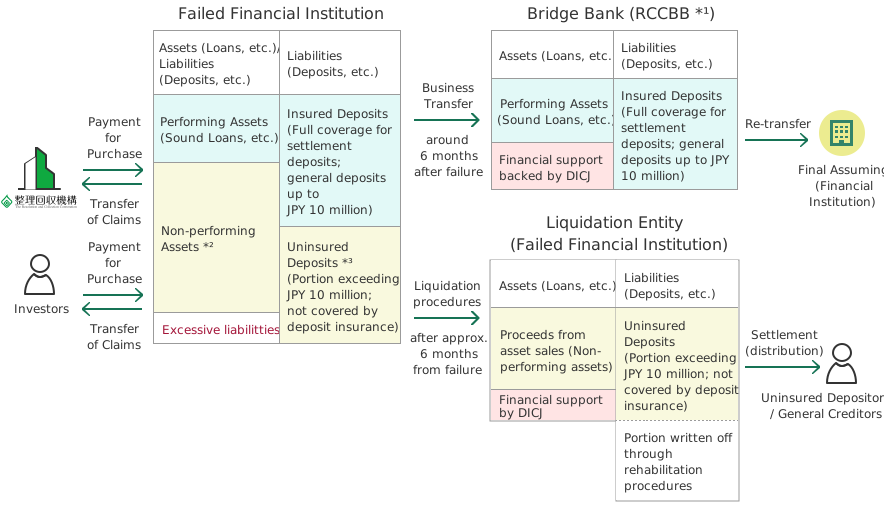
Under the resolution framework with fixed-amount protection, judicial procedures such as those under the Civil Rehabilitation Act are utilized, and the failure date is assumed to be in Friday's evening hours.
After the close of business on Friday, upon receiving notification of failure from the financial institution, the Commissioner of the Financial Services Agency (FSA) issues orders to partially suspend the institution's operations and for a disposition to place its business and assets under the control of a Financial Administrator. At the same time, the Deposit Insurance Corporation of Japan (DICJ) is appointed as the Financial Administrator, and the authority to execute operations and manage and dispose of the assets of the failed financial institution is exclusively vested in the Financial Administrator.
The Financial Administrator temporarily suspends external interface systems such as ATMs and internet banking, and conducts procedures to determine insured deposits(*) in preparation for the resumption of operations on the next business day (Monday), thereby preparing for deposit repayment operations from Monday onward.
Deposits not covered by deposit insurance (i.e., portions exceeding ¥10 million and non-insurable products) are repaid in accordance with the civil rehabilitation plan, depending on the condition of the failed financial institution's assets.
-
(*)
Determining insured deposits refers to the process of aggregating and consolidating multiple deposit accounts held by the same depositor at the failed financial institution in order to ascertain the total amount of insured deposits per depositor. This process is referred to as "name-based aggregation (nayose)."
Meanwhile, apropos loan assets, the Financial Administrator conducts asset assessment and classification within three months following the failure, separating assets into those that are appropriate to be assumed and held by the bridge bank (i.e., sound assets) and those that are not. The former, upon obtaining confirmation from the Commissioner of the FSA by the fourth month, are designated as "eligible assets" and are transferred from the failed financial institution to the bridge bank in the sixth month.
Assets other than eligible assets are sold to purchasers determined through consultation with the court (or supervisor) overseeing the civil rehabilitation proceedings, and are transferred to RCC (post-agreement account) or investors, etc.
Illustration of Failure Resolution under Fixed-Amount Protection
-
*1RCCBB refers to the "RCC Bridge Bank," a general term for RCC's bridge bank operations or the relevant organizational unit (a division within RCC).
To distinguish it from RCC's non-performing loan business (to be determined after agreement), the term "RCCBB" is used. -
*2Assets other than performing assets are sold to RCC (after agreement) or investors, etc., and are used as a source of repayment for uninsured depositors and others.
-
*3Liabilities other than insured deposits are settled through civil rehabilitation procedures, depending on the financial condition of the failed financial institution.