
- Overview
- Overview of the Resolution of Failed Financial Institutions
- Illustration of Failure Resolution Using a Bridge Bank
- Role of RCC as a Bridge Bank
Overview of the Resolution of Failed Financial Institutions
Financial institutions perform important functions such as financial intermediation by accepting surplus funds from individuals and companies and lending such funds to those who require them.
In addition, through services such as withdrawals of cash, deposits and short-term financing, said instituations provide functions that allow customers to use funds when necessary. They also support individuals and companies in efficiently increasing their assets through asset management and products investment. Thus, financial institutions are indispensable to both everyday existence and economic activities.
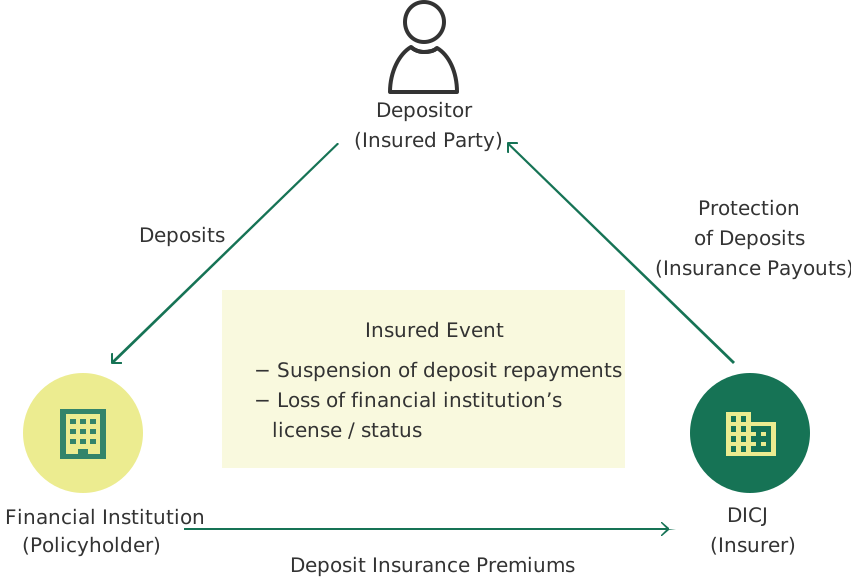
Although financial institutions are essential to people's lives, in the event that a financial institution fails, e.g. due to an inability to repay deposits received from depositors, the Deposit Insurance Corporation of Japan (DICJ), which constitutes the core of the financial safety net, protects depositors from the perspective of depositor protection by, in principle, providing deposit protection up to a certain amount (payoff system) and by promoting the transfer of financial functions and loan assets held by the failed financial institution to a new receiving financial institution.
-
(*)
Under the current system the settlement deposits, such as current deposits and non-interest-bearing ordinary deposits, are fully protected, while general deposits are protected up to JPY 10 million per depositor per financial institution, plus interest accrued up to the date of failure. Deposits protected by deposit insurance are referred to as "insured deposits." When a financial institution fails, only such insured deposits are protected under the payoff system.
Structure of the Deposit Insurance System
However, if a receiving financial institution for the failed institution does not immediately emerge, in order to prevent significant disruption to the smooth supply and demand of funds and user convenience in the region or field in which the failed institution operates, a bank established as a subsidiary of the DICJ will assume deposits and loan assets of the failed financial institution and temporarily maintain and continue its operations. This bank is referred to as a "bridge bank." In addition, there is a bridge bank established under an agreement with the DICJ.
If any difficulties occur when selecting a final receiving financial institution and executing a business transfer within a certain period after the failure (currently assumed to be approximately six months), the bridge bank is expected to be utilized as a temporary receiving financial institution.
By temporarily succeeding operations of the failed financial institutions, such as ensuring depositor convenience, maintaining lending relationships with customers, and sustaining settlement functions, the bridge bank plays an important role in stabilizing the financial system at the time of failure.